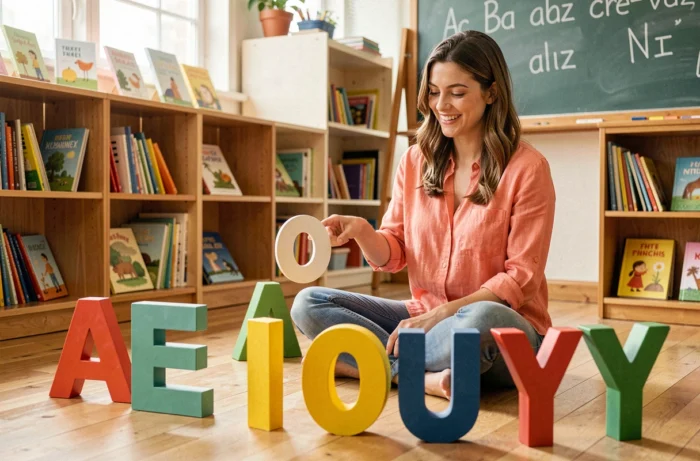
The vowels A, E, I, O, U (and Y depending on the context) are the first phonemes that the child must stabilize before tackling syllables. Research in educational sciences shows that a structured progression, such as “hearing, identifying, manipulating, encoding,” promotes mastery of the alphabetic principle much more than simple visual memorization of the list. Here are five concrete techniques, tested in class or at home, to anchor these sounds durably.
1. The sound hunt in the house
The principle is to transform the daily environment into a phonological playground. Choose a target vowel, for example “O,” and then ask the child to find all the objects whose names contain this sound: bowl, robot, domino, door.
This activity works on auditory discrimination before the visual recognition of the letter. The child first learns to hear the vowel in a word, which corresponds to the first step of the progression recommended by recent school programs.
To easily learn the vowels, this sound hunt can be done in a timed version: a two-minute hourglass and the child must gather as many objects as possible. The competitive aspect (against oneself or against a parent) keeps attention without forcing mechanical repetition.
A useful variant is to change the vowel each day of the week. Monday is dedicated to “A,” Tuesday to “E,” and so on. On Friday, all the vowels are mixed to consolidate.
2. The DIY vowel-image card game
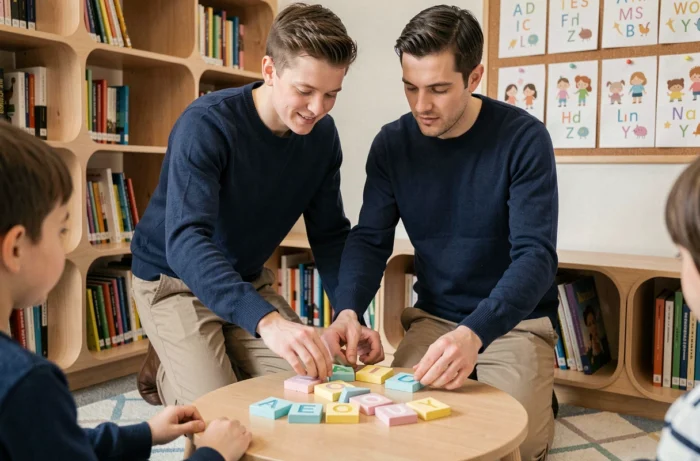
Making your own cards reinforces motor encoding. The child draws an object on one side (a bee for A, an igloo for I) and writes the corresponding vowel on the other side. Drawing and then writing the letter combines three channels: visual, gestural, and phonological.
The cards are then used for several games:
- The classic memory game, where the child flips two cards and must match the vowel to the correct image
- The quick sorting game, where all the cards are spread out and the child sorts each image under the correct vowel in less than a minute
- The guessing game, where one player describes the image without showing it and the other must name the vowel heard in the word
This type of multisensory activity aligns with recommendations from cognitive sciences: combining gesture, sound, and image improves retention compared to a purely visual exercise.
3. Encoding through dictation of invented short words
Once the child recognizes the vowels by ear and in writing, we move on to encoding. The game consists of dictating very short syllables or words, real or invented: “PA,” “RI,” “MOU,” “TILO.” The child must write the vowel they hear.
A study conducted on over 810,000 children in France, reported by Le Monde in September 2026, identified mastery of the alphabetic principle as the best predictor of reading fluency one year later. Writing small words, even invented ones, directly trains this skill.
The playful aspect comes from the fanciful words: “BOKU,” “ZAPI,” “FÉLU.” The child laughs at the absurd word, creating a positive emotional association with the exercise. You can also ask them to invent their own impossible words and spell them out loud.
4. The body rhyme for vowels
Associating each vowel with a body gesture transforms memorization into physical activity. For example: raise arms in a V for A, touch knees for E, point to the sky for I, form a circle with arms for O, point in front for U.
The adult pronounces the vowels in a random order and the child must follow with the corresponding gestures. The pace gradually accelerates. When the child makes a mistake, we go back to a slow speed.
This type of exercise has two concrete advantages:
- It engages procedural memory, which is more durable than declarative memory in young children
- It allows working on the vowels without paper or screen, which is suitable for transition moments (car rides, waiting lines, recess)
- It provides a visible indicator of progress: when the child sequences the six vowels at a fast speed without error, the skill is acquired
The Y can be integrated with a distinct gesture (arms in a Y, logically). Note: in French, the phonological value of Y varies depending on the word. It is relevant to stabilize A, E, I, O, and U before adding Y, as suggested by the kindergarten programs that came into effect in the 2025 school year.
5. The wall tracking chart with stickers
A chart displayed in the child’s room or kitchen, with the six vowels in columns and the days of the week in rows, gives the child a clear view of their progress. Each time they succeed in an exercise related to a vowel, they stick a sticker in the corresponding box.
Visual positive reinforcement works better than occasional verbal validation. The child can see that the “O” has five stickers but the “U” only two, which naturally directs the next sessions towards the least practiced vowel.
This system also avoids the common pitfall of uniform repetition. Parents who have children recite “A, E, I, O, U, Y” in a loop often find that the child recites the series by heart without knowing how to isolate each vowel in a word. The chart, on the other hand, forces targeted work vowel by vowel.
To keep the chart motivating, it is important to set an achievable goal: for example, filling a complete row in a week. The associated reward does not need to be material. Choosing the next invented word for dictation or the next object for the sound hunt is usually sufficient.
These five techniques share a common point: they place sound before letter and action before recitation. A child who hears, manipulates, and encodes a vowel in varied contexts retains it with a solidity that simple alphabetical repetition does not produce.