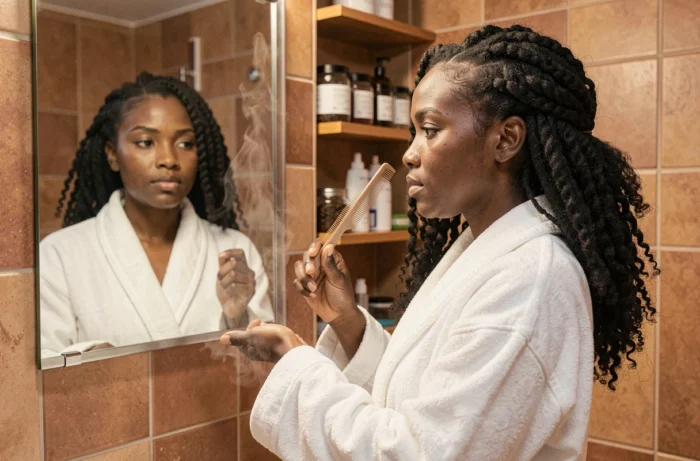
A hair that curls at the first drizzle and another that stays flat despite blow-drying require neither the same shampoo nor the same drying technique. Recognizing your hair type is primarily about observing what happens on your own head between washes, not checking a box on a packaging. Texture, porosity, and scalp condition form a trio that determines almost the entire hair care routine.
Porosity and scalp: the two criteria that classification does not show
Andre Walker’s typology (types 1 to 4, subdivided into A, B, C) remains a useful reference for describing hair shape. It is used daily to choose a haircut or styling product. However, it says nothing about the hair’s ability to absorb water or the condition of the skin that holds it.
Porosity determines the effectiveness of each treatment applied. A simple test can help determine it: place a clean hair in a glass of water and wait a few minutes. If it floats, porosity is low (the cuticles are tight, and the product stays on the surface). If it sinks quickly, porosity is high (the cuticles are open, the hair absorbs quickly but loses moisture just as fast).
On the scalp side, recent trends in the hair care industry are shifting attention towards the skin barrier, microbiome balance, and sensitivity. Brands now offer specific serums, exfoliants, and masks for the scalp, regardless of the texture of the lengths. An oily scalp associated with dry ends is a common situation that the type classification alone does not resolve.
To better understand where you fit into this framework, you can consult the different hair types on Beauté Chic, which details the major texture families.
Washing frequency: adapt shampoo to the scalp, not to the texture
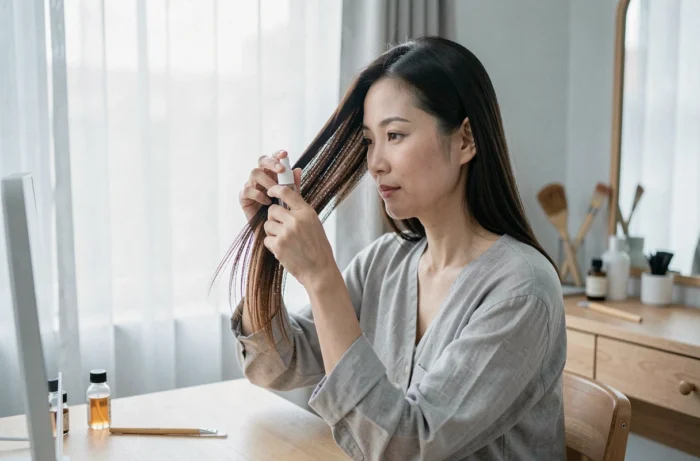
It is often said that one should space out shampoos to avoid damaging the hair. The American Academy of Dermatology recommends rather to adapt the frequency to how quickly the scalp becomes oily or dirty. An oily scalp on straight hair may require daily washing, while thick, curly, or coily hair is washed only when needed.
The practical rule: apply shampoo to the scalp, not to the lengths. The product cleans the scalp while naturally sliding down to the ends during rinsing, which limits fiber dryness. Feedback on this point varies according to thickness and density, but the principle remains the same for all types.
Some concrete guidelines according to hair nature:
- Straight hair (type 1) with an oily scalp: wash every day or every other day, using a gentle shampoo without harsh sulfates.
- Wavy or curly hair (types 2 and 3): two to three washes per week are generally sufficient, supplemented by a co-wash (washing with conditioner) if curls lack definition between shampoos.
- Coily hair (type 4): a weekly wash, sometimes less, focusing on hydration after each contact with water.
Hair routine according to texture: concrete actions for each hair type
Rather than listing products, let’s focus on the actions that truly change the daily outcome.
Straight and fine hair: volume without weighing down
Sebum spreads quickly on straight hair, giving a flat appearance as soon as the day after washing. Applying conditioner only to the ends prevents flattening the roots. Thick oils and hair butters are avoided as they weigh down the fiber. A saltwater texturizing spray can restore body between washes.
Wavy hair: preserve the wave without frizz
Type 2 waves easily lose their shape during drying. Scrunching the hair (pressing it upwards with a microfiber towel right after washing) helps maintain the natural S shape. A lightweight leave-in applied to wet hair is enough to maintain hydration without breaking the wave.
Curls and coily hair: layered hydration
For textures of types 3 and 4, the hair layering technique works well: layer a water-based moisturizing product, then a cream or milk, followed by an oil or butter to seal. This is the LOC (liquid, oil, cream) or LCO principle depending on preferences.
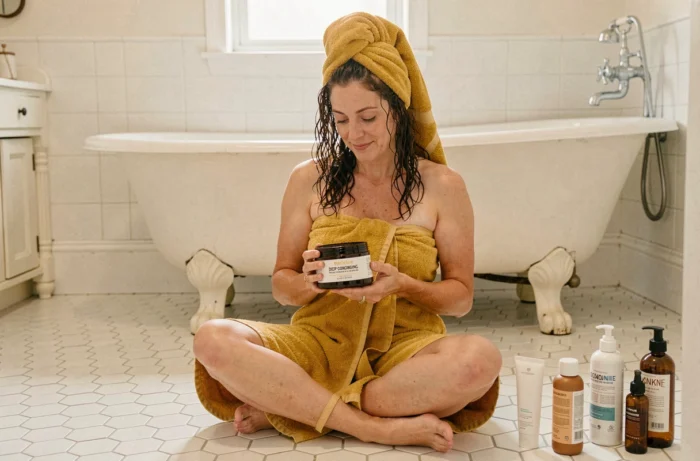
Detangling is always done on damp hair, using a wide-tooth comb or fingers, starting from the ends and moving up to the roots. Pulling on dry coily hair breaks the fiber.
Heat protection: a partial barrier not to be overestimated
Heating devices (straighteners, hair dryers, curling irons) alter the keratin in the hair, increase dryness, and promote breakage. Heat protectants reduce damage without completely eliminating it. This distinction matters, especially on hair that is already colored or bleached, where the fiber is already weakened.
Some reflexes to keep in mind:
- Reduce the device’s temperature to the minimum effective level, rather than always going to the maximum.
- Apply the heat protectant on damp hair, section by section, for even distribution.
- Limit the number of passes of the straightener on the same section, especially on fine or porous hair.
- Space out straightening or curling sessions as much as possible.
On hair already sensitized by chemical treatments, alternating with heat-free techniques (flexible curlers, overnight braids, plopping) protects the fiber in the long term.
The most effective hair care routine starts from what you observe on your own head, not from a trend or a packaging promise. A healthy scalp and properly hydrated fiber produce visible results long before purchasing the latest trendy serum.