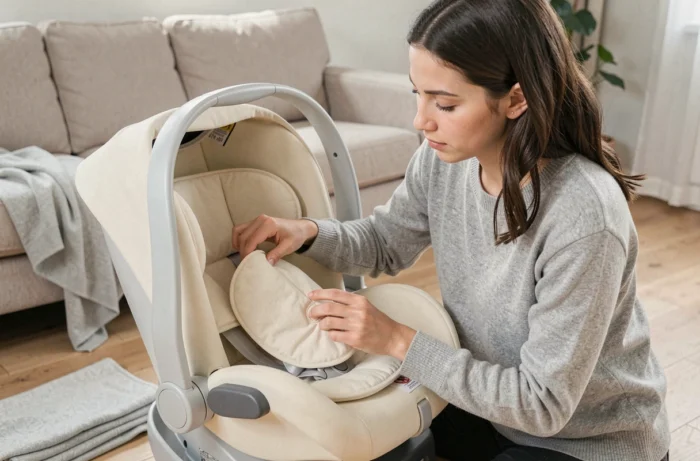
The reducer delivered with a car seat serves a specific function: to fill the gap between the newborn’s body and the car seat shell so that the harness properly secures the straps against the shoulders and hips. Removing this accessory too early or too late poses a safety issue in both cases.
The often cited age of three months is not based on any universal standard. The answer primarily depends on the model of the car seat used and the child’s morphology.
Car Seat Reducer and Regulation R129: A Logic of Size, Not Age
The European regulation R129 (i-Size) classifies car seats according to the child’s stature rather than their weight or age. This approach changes how manufacturers design reducers: the threshold for removal is now expressed in centimeters, sometimes combined with a minimum weight, and not in months of life.
A particularly small four-month-old baby may still need the reducer. Conversely, a two-and-a-half-month-old infant, tall for their age, may already exceed the threshold set by the manufacturer. The manufacturer’s instructions take precedence over any general age rule.
The R129 regulation also mandates rear-facing transport beyond fifteen months for the relevant seats and includes requirements for protection against side impacts. The reducer contributes to this lateral protection for the smallest ones by keeping the head aligned with the shell. Removing it before the child sufficiently fills the shell compromises this protection, even if the harness seems well adjusted.
To delve deeper into the criteria for removal according to brands, you can remove the reducer in the car seat on CM 35 where practical guidelines are detailed model by model.
Harness Adjustment Without Reducer: The Real Safety Test
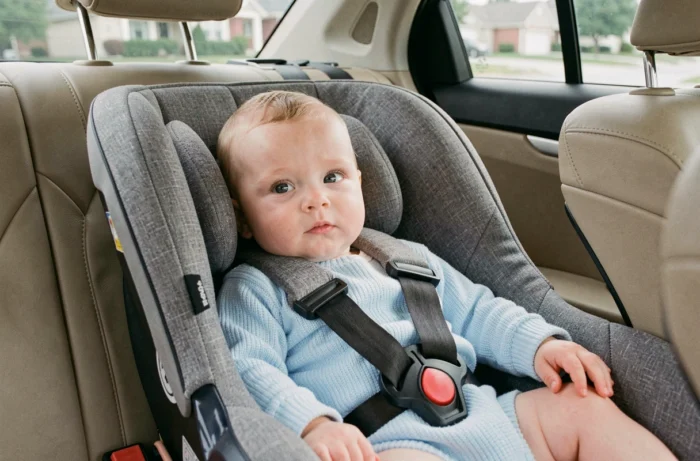
The most reliable indicator for deciding to remove the reducer is neither a weight nor a birthday. It is the quality of the harness adjustment once the reducer is removed. If the straps remain well positioned on the shoulders (at or slightly below shoulder height) and the hips are properly secured without excessive play, the shell fulfills its protective role.
To check this adjustment, conduct a concrete test:
- Remove the reducer and install the child dressed normally (no thick snowsuit, no puffy jacket).
- Buckle the harness and tighten it until you can only slide one flat finger between the strap and the collarbone.
- Check that the child’s head does not tilt forward or to the side when they fall asleep: if the shell is still too large, the head rolls out of the lateral protection zone.
- Observe the position of the chest clip, which should be at armpit level, not on the belly.
If any of these conditions are not met, the reducer remains necessary, regardless of the child’s age. Feedback from parents on forums shows that some three-month-old babies are still too small for their shell without a reducer, while others have removed it as early as two months without any issues with support.
Car Seat Without Reducer in Winter: A Common Safety Trap
The season complicates the decision. In winter, many parents dress their baby in a snowsuit or puffy jacket before placing them in the car seat. A thick garment compresses the harness padding and creates a dangerous gap between the body and the straps in the event of a collision.
This phenomenon is amplified when the reducer is still in place: the space in the shell becomes insufficient, the child sweats, and parents loosen the harness to compensate. The risk of partial ejection during braking increases.
The technical recommendation is to place the child in the car seat without thick clothing and then cover them with a blanket over the buckled harness. This method allows you to keep the reducer as long as necessary without compromising the tightness of the straps. If you remove the reducer because the child seems cramped with their puffy jacket, you solve a comfort issue while creating a safety problem.

Differences Between Car Seat Brands: Why the Guidelines Vary So Much
Each manufacturer sets its own thresholds for removing the reducer, and these thresholds are not interchangeable. Some car seats include a two-part reducer (seat cushion and head support) whose elements are removed separately at different stages of growth. Others use only a single piece with a global removal threshold.
Using a reducer from another brand in a car seat is not recommended because the dimensions, padding thickness, and positions of the harness cutouts differ. Regulation R129 certifies the seat with its original accessories. Modifying this configuration falls outside the scope of certification.
The instructions express the removal threshold in different ways:
- A minimum height in centimeters (often between 60 and 68 cm depending on the models).
- A minimum weight combined with a visual observation (head exceeding the upper edge of the reducer).
- A harness position: when shoulder height reaches a specific notch in the headrest adjustment, the reducer must be removed.
The available data does not allow for a universal threshold to be established. Consult the instructions for your specific model before making any decisions. If the instructions are lost, manufacturers’ websites usually offer manuals for download.
After Removing the Reducer: Monitor the Child’s Growth in the Shell
Removing the reducer is not the final step. The child’s growth continues, and the car seat itself has a usage limit. When the top of the head exceeds the upper edge of the shell, the seat no longer properly protects the head in the event of a rear impact. Transitioning to the next group of car seats then becomes necessary.
The removal of the reducer often marks the beginning of the last third of the car seat’s usage. Regularly monitoring the position of the head in relation to the edge of the shell allows for anticipating the seat change without being caught off guard.
The question of the right time to remove the reducer boils down to a simple principle: it is not a matter of calendar, but of morphology and harness. A reducer removed at the right time, verified by a concrete tightening test, provides better protection than an accessory kept out of precaution while the child is compressed in it.