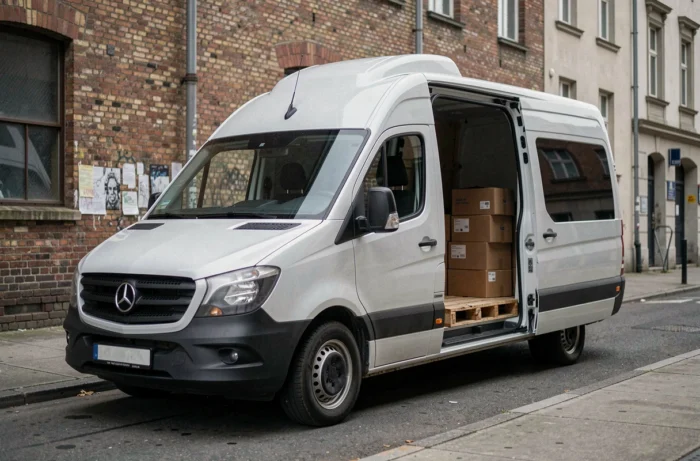
The designation H2 or H3 on a van refers to the useful interior height of the vehicle, a parameter that influences the layout, daily driving, and access to a large part of road and urban infrastructures. Behind two letters and a number lies a technical compromise that goes far beyond the question of standing comfort.
Overall dimensions of an H2 and H3 van: what the measurements change on the road
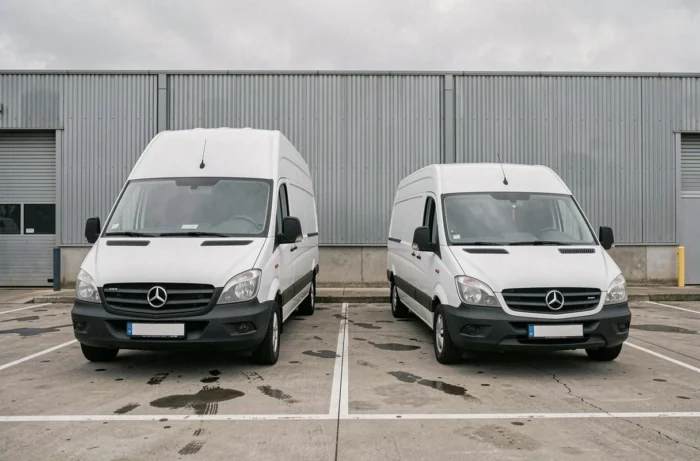
An H2 van, depending on the chassis (Fiat Ducato, Renault Master, Mercedes Sprinter, Volkswagen Crafter), typically has an overall height that exceeds 2.50 m including antenna and roof light. An H3 adds about 25 to 35 cm more, placing the vehicle beyond 2.70 m in most configurations.
This difference may seem modest on a technical sheet. In practice, it determines the list of accessible parking lots, resistance to lateral wind, and fuel consumption. To fully understand the differences between H2 and H3 vans, one must consider usage constraints rather than raw centimeters.
The center of gravity rises with the roof height. A loaded H3 reacts more to gusts on the highway and in exposed valleys. Field reports vary on the actual extent of this phenomenon, but most professional converters recommend testing the loaded vehicle before any commitment.

Access to underground parking and municipal restrictions: the decisive factor
The majority of underground parking lots intended for light vehicles are designed around a clear height of 1.90 to 2.00 m. Neither the H2 nor the H3 can pass under these bars. Therefore, the question does not arise for conventional covered parking: both sizes are excluded.
The difference becomes tangible at access points reserved for utility vehicles, sometimes calibrated to 2.60 m. An H2 can fit in if no roof accessory protrudes. An H3 is often incompatible, even with these widened accesses.
Height bars on the coast and seasonal regulations
In recent years, more and more tourist municipalities have installed height bars at 1.90 m or have issued regulations prohibiting overnight parking of vehicles exceeding 2.00 m in certain beach parking lots, particularly between July and August. These measures explicitly target vans, vans, and small motorhomes.
In this context, an H2 does not have any concrete advantage over an H3 regarding the most common municipal restrictions. The 2.00 m threshold excludes both categories. Only a compact van like the Volkswagen California or equivalent can pass under most of these bars.
Interior layout: ceiling height and false floor
The useful interior height is the most frequently cited argument in favor of the H3. It allows individuals over 1.80 m tall to stand comfortably and, most importantly, to integrate a technical false floor beneath the living area.
This false floor typically accommodates:
- The fresh water and gray water tanks, insulated from freezing by the air and insulation layer of the floor
- The passages for electrical cables, heating ducts, and plumbing, rendered invisible and protected
- A flat storage space for bulky items (sand plates, tools, extension cords)
In an H2, this false floor remains feasible but reduces the ceiling height to a sometimes uncomfortable level for taller individuals. The converter must then balance between technical space and living space, a compromise that is felt daily during extended stays.
Overhead sleeping configuration
A permanent pop-up bed (mounted under the roof) requires sufficient clearance between the mattress and the ceiling to sit up. In an H3, this configuration works without sacrificing the living space below. In an H2, the pop-up bed compresses the living area and often forces the conversion of the bench every evening.
The available data do not allow for a universal threshold: the thickness of the insulation, the type of roof light, and the brand of the chassis can vary the actual height by several centimeters from one van to another.
Consumption, wind resistance, and weight: the trade-offs of the H3
The increased frontal area of an H3 raises aerodynamic drag. On the highway, the extra consumption compared to an H2 of the same length is noticeable, particularly beyond 110 km/h. Field reports vary on the exact figure, but the gap is significant enough to impact the fuel budget for regular use.
The empty weight of the H3 is slightly higher. Combined with a complete layout (insulation, furniture, water, batteries), the vehicle approaches the gross vehicle weight limit more quickly. Staying under 3.5 tons of gross vehicle weight determines the ability to drive with a standard B license and to avoid certain traffic restrictions reserved for heavy vehicles.
- A fully equipped H3 with a complete bathroom, full tanks, and two occupants frequently approaches the gross vehicle weight limit
- An H2 generally leaves a more comfortable payload margin for the same level of equipment
- Weighing the actual load on a weighbridge remains the only reliable method to verify compliance
H2 or H3 van: which usage profile cuts the debate
The choice between H2 and H3 is not just a matter of comfort preference. It involves a series of constraints related to parking, payload, and consumption that accumulate over the vehicle’s lifespan.
An H3 van is fully justified for prolonged mobile residence use, with a technical false floor, permanent pop-up bed, and water autonomy. An H2 is better suited for a mixed use between utility vehicle and weekend van, where the discretion of the size and the payload margin matter more than the ceiling height.
Measuring your own height standing, weighing the layout project on a spreadsheet, and testing the loaded vehicle on a windy highway trip: these three concrete steps guide the decision more surely than any theoretical comparison.