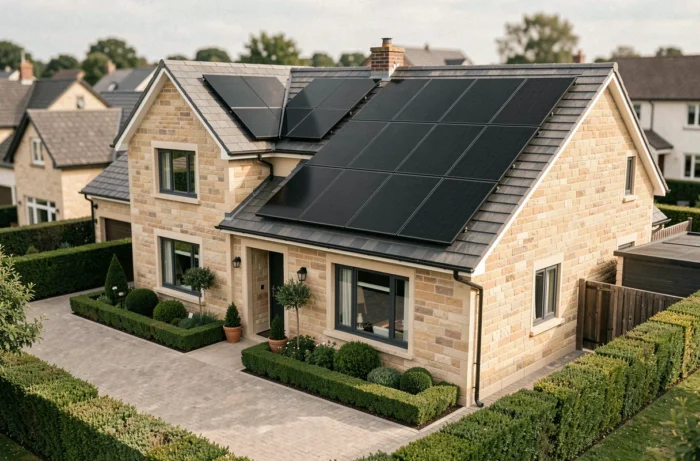
The installation of solar panels on a property modifies several technical parameters that come into play during a real estate transaction: displayed energy performance, projected charges, attractiveness to buyers. The valuation of a property equipped with solar energy depends on specific factors, often misunderstood, that go well beyond the mere presence of modules on the roof.
Connection and documentation: what conditions the actual valuation
A point rarely addressed by sellers: the added value of a photovoltaic installation relies as much on its documentation as on its power. A grid-connected installation must be declared to Enedis, and the surplus purchase contract (or total self-consumption) must be transferable to the buyer.
The seller has every interest in compiling a complete file. The documents to gather include purchase and installation invoices, the Consuel compliance certificate, the connection contract, and production reports over several years. Without these documents, the installation may be perceived as a risk rather than an asset.
Administrative constraints do not stop there. If the panels were installed without prior declaration of work or without compliance with local urban planning rules, regularization may delay the sale. To learn more about the Solar Energy Guide, the administrative procedures related to photovoltaics are detailed according to each configuration.

EPC and solar panels: a less direct link than one might think
The energy performance diagnosis has become a sorting criterion for buyers. Many homeowners believe that installing solar panels is enough to improve their rating. The reality is more nuanced.
The EPC measures a conventional energy performance, based on the characteristics of the building and equipment, not on the actual savings observed or on the income derived from electricity sales. A photovoltaic installation can help improve the score, but it does not compensate for poor insulation or an outdated heating system.
Since January 1, 2025, the obligation for energy audits extends to individual houses and multi-unit buildings classified as E, in addition to classes F and G already affected since April 1, 2023. The solar installation may appear in the list of recommended work from the audit, but it does not replace the audit itself or the identified priority renovations (attic insulation, window replacement, ventilation).
In other words, solar works as a complement in a comprehensive energy renovation strategy. Presented alone against a poor EPC, it is not enough to reassure an informed buyer.
Collective self-consumption in co-ownership: an underutilized lever
The valuation through solar does not only concern individual houses. In co-ownership, collective self-consumption opens up concrete prospects for reducing common charges and making the building more attractive on the market.
The principle: panels installed on the roof of the building supply electricity to common areas (lighting, elevator, ventilation) or are distributed among several apartments. The reduction of common charges benefits all co-owners, even those who do not directly consume the produced electricity.
The law on the acceleration of renewable energy production (APER law, 2023) has facilitated the adoption of these projects in general meetings. Depending on the chosen arrangement, a simple majority vote may suffice, which removes a historical barrier in co-ownerships where unanimity blocked any initiative.
- Collective self-consumption reduces dependence on the grid and stabilizes part of the projected charges, a strong argument in a context of rising electricity prices.
- The distribution contract among co-owners must be clear and transferable upon sale, so that the buyer immediately understands the financial benefit.
- The installer must be certified and the connection compliant with Enedis requirements, under penalty of complications during ownership transfer.
Solar profitability and sale price: what buyers really look at
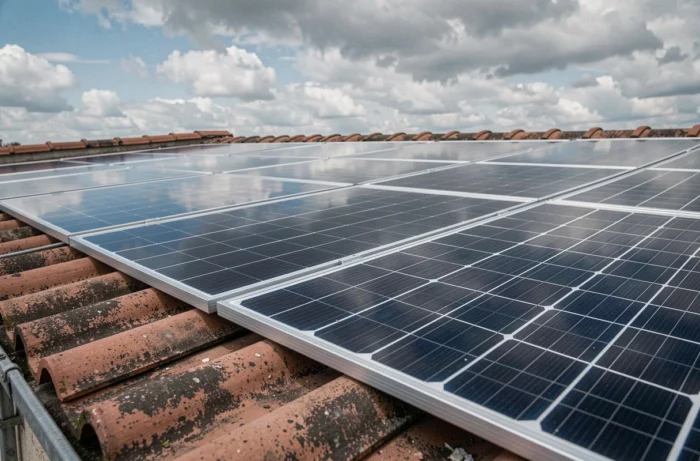
Buyers are no longer satisfied with an ecological argument. What sways a decision is the demonstrable profitability of the photovoltaic installation: annual production, self-consumption rate, amount of surplus sold, and remaining duration of the purchase contract.
A buyer discovering a ten-year-old installation without production reports or an active resale contract will have legitimate doubts about the condition of the modules and the economic viability of the system. Conversely, a file showing stable production, an amortized investment, and a buyback contract still in effect for several years constitutes a strong negotiation argument.
The quality of the equipment also matters. Entry-level panels without long-term manufacturer warranty, or an inverter already replaced, weigh on the buyer’s perception. A well-documented solar investment reassures as much as a new kitchen or a renovated roof.
Real estate professionals note that buyers’ sensitivity to solar equipment is increasing, driven by rising electricity prices and the growing visibility of self-consumption projects. A well-equipped property, properly maintained and accompanied by its technical documentation stands out clearly in listings.
The actual added value depends on location (sunlight varies greatly by region), installed power, and coherence with the rest of the building. A solar project grafted onto a thermal sieve without other improvement work will have a limited effect on the sale price. In contrast, combined with a comprehensive energy renovation, photovoltaics becomes a value-accelerating factor that appeals to both the wallet and the energy rating of the property.