
Converting grams to liters involves transitioning from a unit of mass to a unit of volume. These two quantities do not measure the same thing, and the bridge between the two relies on a single variable: the density of the ingredient in question. Without this information, any grams-to-liters conversion remains an approximation, or even a mistake.
Density: the concept that makes conversion possible
Density expresses the mass contained in a given volume. For pure water at room temperature, one liter weighs about one kilogram, which simplifies the calculation: 1 g corresponds to 1 ml. This practical reference has become a convention in cooking.
The problem arises as soon as we move away from water. Flour, sugar, oil, cream, or grated cheese do not have the same density. Two ingredients with the same mass do not occupy the same volume, and vice versa. Oil, for example, is less dense than water: one liter of oil weighs less than one liter of water. Flour, depending on whether it is packed or aerated, varies significantly.
To delve deeper into the grams to liters conversion on Agir Emploi, one must first accept that the shortcut “1 g = 1 ml” really only works for water.
Grams to liters conversion formula and practical application
The formula is straightforward: volume (in liters) = mass (in grams) / (density x 1,000). Density is expressed here in g/ml or kg/L, which is numerically equivalent.
Let’s take water. With a density of 1, dividing the mass in grams by 1,000 gives the volume in liters. For oil, which has a density around 0.9, the same weight occupies a slightly larger volume. For flour, whose density varies depending on compaction, the result can change significantly.

This calculation seems simple on paper, but it assumes knowledge of the exact density of the ingredient. However, this value changes depending on temperature, granularity, or the state of the product (melted, solid, powdered). This is where generic tables show their limitations.
Why grams-liters conversion tables can be misleading
“Ready-to-use” conversion tables are abundant online. They provide fixed equivalences: so many grams of flour for a certain volume, so many grams of sugar for another. These references are useful for quick use, but they create a false sense of precision.
Several factors make these tables approximate:
- Sifted flour and flour packed in a bag do not have the same density. A cup of sifted flour weighs significantly less than a cup taken from the bottom of the bag.
- Icing sugar, powdered sugar, and granulated sugar occupy different volumes for the same mass. Applying a single factor skews the measurement.
- Temperature alters the density of certain liquids. Warm oil is slightly less dense than cold oil, which shifts the obtained volume.
- Grated cheese, dried herbs, or cocoa powder have very variable densities depending on the brand and packaging.
A reliable table always specifies the state of the ingredient (sifted, packed, melted, at room temperature). Without this mention, the displayed value remains an average that can deviate from reality by several tens of grams over an entire recipe.
When to recalculate with the actual density
In baking, where proportions matter to the nearest gram, relying on a generic table to convert grams to liters can compromise the result. Recalculating with the actual density becomes necessary as soon as precision determines success: choux pastry, ganache, crème brûlée mixture.
For a soup or a vinaigrette, the approximation of a table is sufficient. For a cake whose texture depends on an exact butter/flour ratio, it’s better to weigh directly in grams with a scale or check the specific density of the ingredient before converting.
Converting without a scale: common kitchen utensil references
When the scale is absent, everyday utensils serve as volumetric references. Their reliability depends on the ingredient, but they effectively help for tolerant preparations.
| Utensil | Approximate Volume |
|---|---|
| Teaspoon | 5 ml |
| Tablespoon | 15 ml |
| Mustard glass | 20 cl |
| Yogurt pot | 12.5 cl |
| Standard cup | 25 cl |
These volumes only translate into grams based on the density of what is placed in them. A mustard glass filled with flour does not weigh the same as a mustard glass filled with sugar. The volume of the utensil is fixed, the mass of its contents is not.
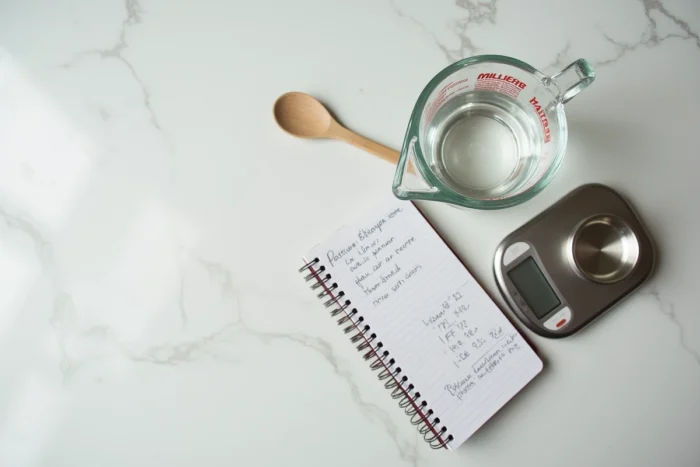
Tip for common liquids
For water, milk, or vinegar, whose density remains very close to 1, the conversion is almost direct: 20 cl in a mustard glass corresponds to about 200 g. For oil, mentally subtracting a tenth gives a more accurate estimate (20 cl of oil weighs more around 180 g).
For powders and solids, no mental shortcut replaces the knowledge of the specific density of the ingredient. Online converters by ingredient, which directly incorporate this data, then offer a superior precision to generic tables.
Thus, converting grams to liters boils down to a simple arithmetic operation, provided you have the correct density. Keeping this reflex, checking the exact state and nature of the ingredient before applying a conversion factor, avoids discrepancies that can ruin a recipe or skew a measurement.