Searching for land to live autonomously first involves balancing legal, budgetary, and agronomic constraints that rarely overlap. The ideal land for a life of autonomy and freedom does not exist in itself: it results from a methodical sorting of what urban planning law allows, what the soil can produce, and what the budget realistically permits.
Agricultural, buildable, or leisure land: what the law really allows
Most guides list physical criteria (water, exposure, area) without mentioning the constraint that eliminates the majority of plots even before a visit: the classification of the land in the local urban planning plan. Non-buildable agricultural land prohibits any classic permanent residence. Leisure land allows for temporary shelter, rarely a year-round dwelling.
The ALUR law has opened a breach by recognizing removable residences as the permanent habitat of their users. Since the implementing decree, a tiny house, yurt, or lightweight habitat can be installed on non-buildable land, provided that the municipality has planned it in its urban planning document. In practice, few municipalities have included these designated spots, which significantly limits possibilities.
| Type of land | Classic permanent residence | Lightweight habitat (ALUR law) | Main constraint |
|---|---|---|---|
| Buildable (zone U or AU) | Yes | Yes | High price, often limited area |
| Agricultural (zone A) | No (except for operators) | Possible if PLU spot | Need for a link to agricultural activity |
| Natural / forest (zone N) | No | Very restricted | Classified wooded area, strong restrictions |
| Leisure land (STECAL) | No | Possible depending on deliberation | Use limited to a few months a year without exemption |
This table summarizes the current legal situation. Before any land search, consulting the PLU or PLUi of the target municipality remains the first step, well before checking soil quality or access to water. To delve deeper into this step, the autonomous land guide on Immo Relax details the administrative procedures to be undertaken in advance.
Land prices in rural areas: where the gaps are
The price of land determines the financial viability of an autonomy project. The gap between free agricultural land and buildable land remains considerable across France. The pressure on agricultural land is increasing even though price rises have slowed since 2024.
Buildable land for individual houses displays prices that remain out of reach for many residential autonomy projects. In contrast, non-built agricultural land retains significantly more accessible prices, with marked variations from one department to another.
Variables that affect the budget
- Development (connection to water, electricity, sanitation) can represent a significant portion of the total budget on isolated land, sometimes as much as the land itself.
- A bare plot in an agricultural zone costs a fraction of the price of buildable land in the same area but requires resolving the issue of occupancy status.
- Notary fees on non-built land are proportionally higher than on classic real estate, which increases the actual acquisition cost.
In practice, a project holder aiming for autonomy often benefits from targeting departments where agricultural land remains affordable and where urban planning documents already provide favorable provisions for lightweight habitat.
Agronomic and hydric criteria for viable autonomous land
Once the legal and budgetary constraints are lifted, three physical parameters determine the actual capacity of a plot to support an autonomous life: access to an exploitable water source, the agronomic quality of the soil, and sunlight exposure.
Water is the most discriminating factor. A plot without a source, without a possible well, and without a nearby watercourse does not allow for food autonomy. The presence of water is not enough: it is necessary to check the flow during the summer, the physico-chemical quality, and the usage rights (withdrawals from watercourses are subject to declaration or authorization depending on the volumes).
Soil and nutritional capacity
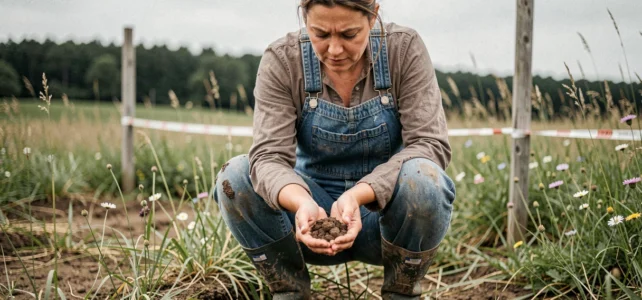
A compact clay soil does not produce the same results as a deep loamy soil. Having the soil analyzed before purchase avoids years of costly corrections. A basic soil test (pH, texture, organic matter) is inexpensive and provides a clear reading of the plot’s market gardening potential.
South-facing orientation and protection against prevailing winds condition the growing season. A plot in a valley bottom freezes earlier and longer than a plot on a mid-slope. This difference can shorten the productive period by several weeks.
Lightweight habitat and energy autonomy: intersecting constraints
Installing a lightweight habitat (tiny house, yurt, cabin) on rural land involves simultaneously resolving the issues of energy and sanitation. An off-grid habitat must produce, store, and manage its resources without connection.
Photovoltaic solar energy covers current electrical needs in most French regions, provided that battery storage is correctly sized for periods of low sunlight. Wood heating remains the most common solution in isolated rural areas, subject to access to local forest resources.
Individual non-collective sanitation (ANC) is mandatory on land not connected to the sewer system. Approved compact systems and dry toilets (allowed under certain conditions) offer suitable alternatives for lightweight habitats, but their installation must comply with current regulations.
The choice of land for a life of autonomy rarely hinges on a landscape crush. It is the convergence of a favorable legal status, a manageable price, and a soil capable of producing that distinguishes viable land from an administrative dead end. Checking the PLU before dreaming of a vegetable garden remains the most profitable reflex of the entire process.