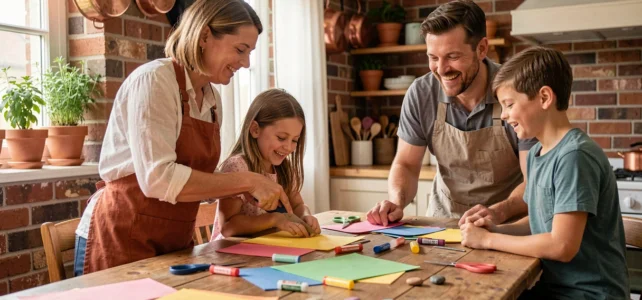
Sales of creative materials have increased by about 30% in France since 2020, according to Facefull News. A 2023 Ipsos survey indicates that one in two French people dedicates at least one hour a week to a manual or artistic activity. These figures indicate a shift: creative hobbies are no longer limited to keeping children occupied during vacations; they are establishing themselves as a regular family practice, halfway between relaxation and shared learning.
Creative activities for families: what health research confirms
An article from The Portugal News reports that a global review of around 3,000 studies concludes that the practice of arts plays a significant role in preventing health problems and promoting well-being. This finding extends beyond the school or therapeutic context: it also concerns informal workshops conducted at home, with family, without any particular artistic pretension.
Modeling clay, painting a mural on cardboard, assembling a herbarium after a walk—these activities engage fine motor skills in children and produce a mental slowing effect in adults. Field reports vary on the intensity of this effect depending on profiles, but the general direction is documented.
When looking for ideas to organize such moments, leisure activities on Mimi La Cocotte can be found among the resources that compile concrete suggestions suitable for different ages. The starting point remains the same: choose an activity whose difficulty is appropriate for the youngest participant, then allow the older ones to complicate their own creation.
Home escape game: designing a puzzle rather than consuming one
Commercial escape games are expensive and impose a rigid framework. Creating your own scenario at home reverses the logic: preparation itself becomes the creative activity, and solving it is merely an extension.
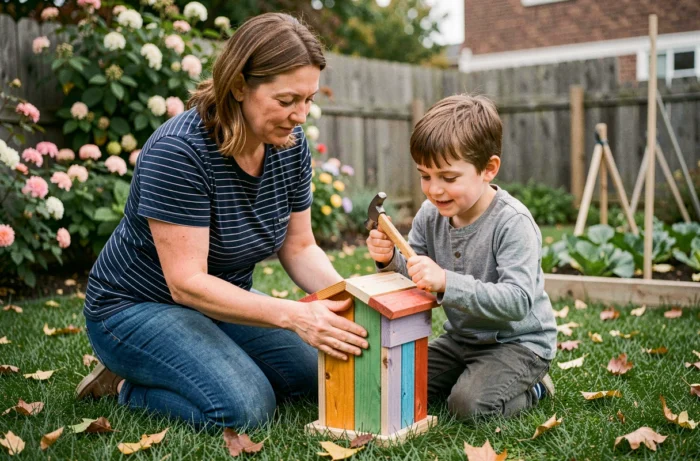
The principle consists of three steps that work with children from six or seven years old.
- Define a theme and a location (a room in the house, the garden, a garage) and then write a short scenario with a clear objective: find a hidden object, decipher a message, open a locked chest
- Create the puzzles on paper (rebus, color codes, puzzles cut from cardboard) calibrating the difficulty so that each family member can solve at least one challenge alone
- Prepare false leads and a timer to add tension without frustration, providing a backup clue for each puzzle
The creation of the game often takes longer than the game itself, and this is precisely where the educational interest lies. Children who design the challenges work on writing, calculation, and spatial logic without feeling like they are doing an exercise.
DIY nature: turning an outdoor outing into a creative workshop
Collecting natural elements (leaves, pebbles, branches, dried flowers) to make something is an ancient practice. What changes is the way to structure this collection so that it becomes a real family project over several days.
A classic herbarium remains a solid support. Each family member chooses five to ten specimens during a walk, dries them between two sheets of newspaper under heavy books, and then glues them onto cardboard pages noting the name, location, and date of collection. The family herbarium becomes a memory object that is completed over the seasons.
Painting on pebbles offers a quicker alternative. Flat pebbles, acrylic paint, and a finishing varnish are all that’s needed. The youngest paint faces or simple animals, while teenagers can attempt geometric patterns or miniature landscapes. The finished pebbles serve as garden decorations, paperweights, or pieces for a homemade memory game.
In major French cities, the number of manual creation workshops surpassed that of yoga classes for the first time in 2022, with a 35% increase in registrations for pottery, sewing, or woodworking sessions in just one year. This trend shows that manual activities attract well beyond the family audience, but families find a particularly fertile common ground there.
Manual activities with recycled materials: DIY without a budget
One of the barriers to creative hobbies in families is the perceived cost of materials. Cardboard rolls, cork stoppers, glass jars, fabric scraps, egg cartons: most households already have everything needed to start a workshop.
Cut and painted egg cartons become caterpillars, flowers, or small articulated characters. Toilet paper rolls transform into binoculars, rockets, or stackable animals. No additional purchases are necessary for a full afternoon of activity.
- Cardboard boxes: miniature huts, marble runs, puppet theaters with a cut-out opening and a curtain made from fabric scraps
- Cork stoppers: personalized stamps, small boats to float in the bathtub, painted figurines
- Newspaper: papier-mâché for sculpting masks or decorative bowls, folded hats, cut garlands
- Glass jars: dry terrariums with moss and pebbles, painted lanterns, snow globes with glycerin and glitter
This type of DIY presents a direct educational advantage: it makes the concept of reuse visible. Children who make a toy from waste concretely integrate the principle of recycling, without theoretical discourse.
The choice of creative activity matters less than the regularity. A family that establishes a weekly ritual, even just thirty minutes on Sunday afternoons, builds a shared habit whose effects on bonding and reduction of screen time can be measured over weeks.
The available data does not allow for precise quantification of this benefit, but the trend observed since 2020 confirms that households that regularly engage in manual activities together report a clear improvement in their family life.