
The comfort of a home is not limited to its winter energy class. An analysis of over 16 million energy performance certificates (DPE) conducted since 2021 reveals that nearly half of French homes have insufficient summer comfort, with a degradation trend observed since 2024. Improving one’s habitat requires addressing the thermal envelope, water management, ventilation, and space layout simultaneously, without limiting oneself to decorative reflexes.
Summer comfort and thermal inertia: the weak point of recent renovations
Homes renovated to meet the requirements of the winter DPE often combine enhanced insulation and tight air sealing. These two parameters, effective in winter, turn the home into a thermal trap as soon as outdoor temperatures rise.
The problem stems from a structural flaw: the principles of winter comfort and summer comfort are sometimes contradictory. For example, interior insulation made of mineral wool does not store any nighttime coolness. Without inertia (thermal mass exposed – concrete slab, stone wall, earth plaster), the heat accumulated during the day remains trapped in the living space.
We recommend checking three points before any intervention on the envelope:
- The presence of external solar protections (shutters, adjustable sun blinds, projection awnings) on south and west-facing windows, which are much more effective than interior curtains that allow radiation to pass through the glazing.
- The ratio between glazed surfaces and available thermal mass in each room: a highly glazed living room without an exposed slab or heavy wall will systematically overheat.
- The possibility of cross-ventilation at night, the only passive mechanism capable of expelling heat stored during the day without resorting to air conditioning.
On conseils-habitat.fr, these trade-offs between winter insulation and summer protection are detailed with concrete cases according to building typologies.
Heating regulation and set temperature: adjustments that impact the bill
Lowering the set temperature by just one degree measurably reduces heating consumption. However, we observe that the majority of domestic installations operate without room-by-room regulation, which amounts to uniformly heating spaces with very different needs.
A properly configured boiler with thermostatic valves in each room allows for temperature adjustments based on actual usage. The bedroom does not need the same setting as the living room, and a hallway even less so. The savings on the energy bill come less from the type of boiler than from the quality of the regulation.
Older installations deserve a check of the heating curve (the relationship between outdoor temperature and water departure temperature). A poorly adjusted curve sends water that is too hot into the radiators during mild weather, leading to frequent on/off cycles and direct overconsumption.
Time programming and intermittency
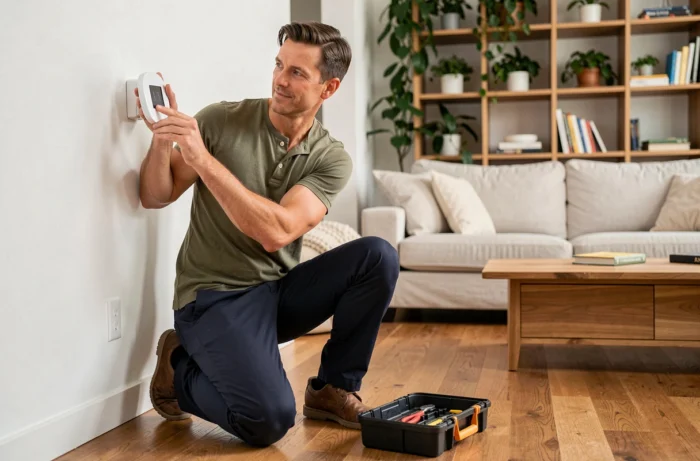
Programming a temperature reduction during absence hours and at night remains the most cost-effective lever. A wired programmable thermostat is inexpensive and connects to most wall-mounted boilers.
On the other hand, completely turning off the heating for several days in a poorly insulated home causes a drop in inertia that forces the system to work harder upon restarting. Maintaining a reduced temperature rather than turning off is preferable for buildings with low inertia.
Ventilation and indoor air quality: beyond manual airing
Opening windows for ten minutes a day is not enough to ensure air renewal that meets the sanitary needs of an occupied home. Humidity produced by breathing, cooking, and showers accumulates in damp rooms and migrates to cold walls, promoting condensation and mold.
A single-flow humidity-controlled mechanical ventilation system adjusts its flow to the humidity level detected in each room. This is the most common system in renovations, but its effectiveness depends entirely on maintenance: clogged extraction vents can reduce actual flow by two or three times.
We recommend cleaning the extraction vents every six months and checking the motor unit every three years. In the bathroom, persistent condensation on the windows after a shower indicates insufficient extraction flow.
Humidity and perceived comfort
The ideal relative humidity level in a home is between 40 and 60%. Below this, mucous membranes dry out and discomfort increases despite a correct temperature. Above this, a feeling of dampness sets in, and organic materials (wood, textiles) deteriorate.
A hygrometer placed in the main living area allows you to check if the ventilation is fulfilling its role. If the level remains above 65% in winter despite a functional ventilation system, the problem often comes from water infiltration or a sealing defect at the lower part of the walls.

Space layout and thermal curtains: underestimated levers
The layout of a space directly affects air circulation and heat distribution. A piece of furniture placed in front of a radiator blocks the convector and creates a cold zone in the rest of the room. A sofa backed against an uninsulated exterior wall creates an unpleasant cold wall sensation, even with a correct ambient temperature.
Thick thermal-lined curtains significantly reduce heat loss through windows at night, provided they cover the entire glazed surface and extend to the floor. A curtain that stops halfway allows cold air to slip under the fabric due to natural convection.
In summer, these same curtains become counterproductive if they are dark-colored on the window side: they absorb solar radiation and re-emit heat into the room. A light-colored curtain on the glazing side or, better yet, an exterior shutter closed during direct sunlight hours remains the only effective defense.
Improving daily comfort rarely comes from a single spectacular gesture. It is the accumulation of fine adjustments (heating curve, ventilation flow, furniture positioning, choice of solar protections) that produces a tangible result on the energy bill and on the occupants’ experience, season after season.