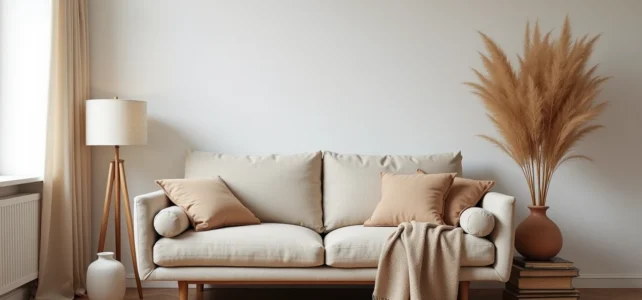
What palettes, materials, and design choices are truly shaping interior decoration right now? Rather than listing decor ideas without hierarchy, this article compares the major trends that are redefining our interiors, from the retreat of pure white to the rise of textured finishes, along with a slower approach to design.
Trendy colors in interior decoration: what replaces white
The white wall as a universal reflex, especially in small spaces, is losing ground. Natural shades are taking over with a precise logic: each color corresponds to a specific use and desired feeling.
| Palette | Representative shades | Desired effect |
|---|---|---|
| Deep greens | Eucalyptus, forest green | Grounding, connection to nature |
| Beiges and sands | Hemp, greige, light brown | Soft brightness without coldness |
| Mineral blues | Stone blue, slate blue | Calmness, visual depth |
| Desaturated terracotta | Rosy ochre, muted burnt earth | Contained warmth, organic tone |
According to Venidom, these trendy colors for 2026 express a need for emotional stability: they are designed to soothe and secure the occupants. This link between palette and mental health goes beyond mere aesthetic choice.
Browsing the decor section of Les Embellies Déco, one can find this orientation towards organic tones that prioritize visual comfort over spectacular effects.
Desaturated terracotta and forest green work particularly well in main living spaces, where we spend the most time. In contrast, mineral blues find their place in bedrooms and relaxation areas, where the depth of the tone encourages disconnection.
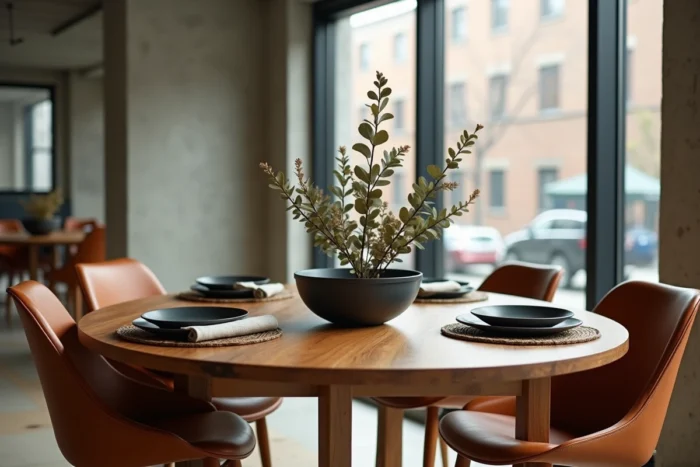
Textured finishes: lime effect, microcement, and slatted panels
The change is not limited to color. The way materials are applied to walls and floors transforms the perception of an interior as much as the color itself.
Textured finishes are replacing smooth surfaces in the majority of recent projects. Three techniques dominate.
- The lime effect, which gives walls a slightly irregular and velvety appearance, absorbs light instead of reflecting it. It softens any room without making it dark.
- Microcement, applied in a thin layer over an existing floor or countertop, creates a continuous mineral surface without joints. It is suitable for both a bathroom floor and a kitchen island.
- Slatted panels (natural or stained wood) add vertical relief, structure an accent wall, and improve the acoustics of an open space.
These three finishes share a common point: they introduce tactile depth. A greige lime effect wall does not produce the same result as a wall painted in matte greige. Natural light catches the micro-reliefs and varies the ambiance throughout the day.
Slow decor: decorating less to decorate better
The most defining trend is not about a color or a material, but a method of purchasing and designing interiors. Slow decor, which has been significantly on the rise in recent years (particularly in urban areas), reverses the logic of rapid renewal.
The principle can be summarized in three concrete choices.
Thoughtful purchasing over accessory accumulation
A piece of furniture chosen to last replaces several disposable items. This requires accepting a higher unit budget, but the overall cost over several years decreases. Solid wood, thick linen, or artisanal ceramics age better than their industrial counterparts and develop a patina instead of degrading.
Overall coherence rather than piece by piece
Decorating in slow decor means thinking of the entire house as a whole. Colors flow from one room to another, and materials respond to each other. A coherent interior appears larger than an eclectic one, because the eye is not interrupted by style breaks at every door threshold.
Long-term and embraced empty spaces
Leaving a wall bare or a corner of a room without furniture is not an oversight. It is a choice that allows the space to breathe and enables the integration of an object later, when it is truly found. Slow decor considers emptiness as a legitimate decorative element.
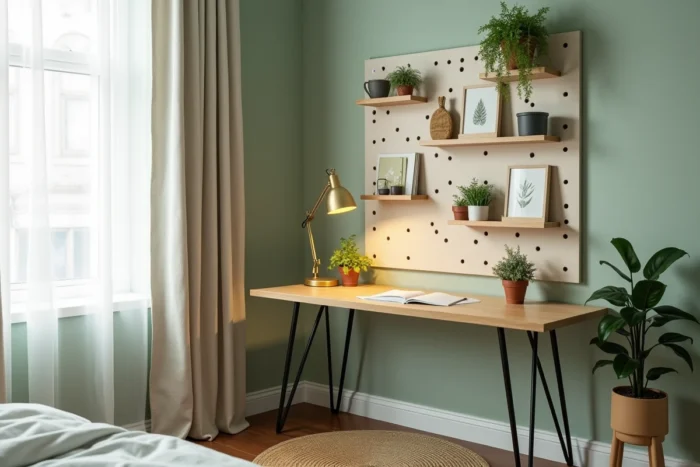
Light and wallpaper: two underestimated levers in decoration
Among the concrete levers to enhance an interior, two remain underutilized in current projects.
Artificial light is often treated last, after choosing furniture and paint. This is a sequencing error. Poorly thought-out lighting negates the effect of a carefully curated palette. Warm shades on the walls require light sources whose color temperature does not lean towards cold white. Multiplying low light points (table lamps, downward-facing sconces) rather than a single central ceiling fixture radically changes the perception of a room.
Wallpaper, long associated with dated interiors, is making a comeback in textured versions or subtle geometric patterns. Applied to a single wall in a bedroom or hallway, it creates a focal point without overwhelming the space. Current non-woven versions are easier to install and remove than traditional pasted papers, reducing the barrier to entry for those who hesitate.
Conversely, combining busy wallpaper and strong colored walls in the same room almost always produces a confusing result. A single strong visual element per room remains the most reliable rule for maintaining balance.
The common thread of all these orientations remains the same: the interiors that work best right now are those that reduce the number of visible elements while increasing the quality of each of them. Raw materials, tightened palettes, tactile finishes, and liberated spaces form a more sustainable framework than an overloaded decor renewed each season.