
A LMS does not replace a skills development plan. It structures the execution, traceability, and management of that plan. Confusing the two means underutilizing the tool or, worse, believing that simply deploying a platform is enough to meet legal obligations. We observe that the companies that derive the most value from a LMS are those that integrate it into their overall HR processes, not those that treat it as a catalog of e-learning modules.
Traceability of professional interviews and legal compliance via a LMS
The obligations related to professional interviews have tightened. A first interview must take place within the year following hiring, followed by a career interview every four years, complemented by a summary assessment every eight years. Each exchange must be documented: current skills, training needs, planned mobility, VAE or retraining through work-study.
Without a centralized tool, this traceability relies on scattered spreadsheets, PDF files archived in shared folders, and evidence that is difficult to retrieve in case of an audit. A LMS centralizes training histories, certifications, and attestations in a single repository. It links each interview to the actual paths followed, past evaluations, and validated skills.
This is not just administrative comfort. It is an imperative. When the company must prove that it has met its training obligations, the burden of proof falls on it. A well-configured LMS automatically generates the necessary records. Adopting a LMS for employee training in the company thus secures the legal management of career paths, not just the dissemination of content.
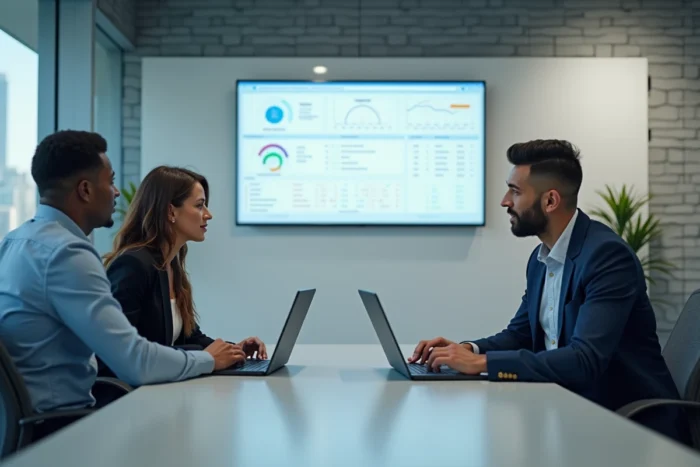
Skills management: linking training paths and job reference frameworks
Most articles on LMS describe features (quizzes, videos, SCORM, gamification). We recommend thinking differently: a high-performing LMS articulates each module to a skills reference framework. Without this articulation, the platform is just a content server.
Concretely, this involves three technical mechanisms:
- A mapping between the educational objectives of each path and the target skills of the job reference framework, so that each completed module automatically feeds into the employee’s profile.
- Conditional assignment rules: the LMS proposes a skills development path only if the previous evaluation reveals an identified gap, not an open catalog for everyone by default.
- A structured export to the HRIS, so that training data feeds into personnel reviews, succession plans, and annual interviews without manual re-entry.
This level of integration distinguishes a mature LMS from a simple dissemination tool. It transforms training into a documented and auditable process, aligned with the strategic management of employment forecasting.
Real cost of a LMS: the items that vendors do not detail
Vendors’ pricing grids display a cost per active user or per license. This price represents only a fraction of the actual budget. We regularly observe significant discrepancies between the announced price and the total cost of ownership.
The first underestimated item is content engineering. Buying a LMS without a budget for pedagogical production is like buying an empty library. Creating a quality interactive module (scripting, filming, integration, testing) requires internal resources or a specialized provider. Multiplied by the number of job paths to cover, this item often exceeds the cost of the license itself.
The second item is content maintenance. An outdated regulatory module not only has zero pedagogical value, it creates a legal risk. A revision cycle must be planned, with a responsible person identified for each area.
The third item concerns change management. A LMS deployed without internal communication, without training managers on its use, and without support within teams, shows anemic connection rates after a few weeks. The adoption rate depends more on support than on the platform’s ergonomics.
Choosing between SaaS LMS and on-premises hosting
A SaaS (cloud) LMS reduces infrastructure and technical maintenance costs. In return, the company depends on the vendor’s update schedule and data hosting choices. For sectors subject to sovereignty or strict confidentiality constraints (defense, health, finance), on-premises or private cloud hosting remains relevant despite a higher operating cost.
The choice is not binary. Some vendors offer hybrid architectures, with sensitive data hosted locally and generic content delivered via SaaS.
LMS and HRIS integration: the technical friction point to anticipate
We find that the main factor for failure in a LMS project is neither the choice of platform nor the quality of content. It is the absence of bidirectional integration with the HRIS.
Without automated connection, personnel movements (arrivals, departures, internal mobility) do not reflect in the LMS. Employees who left months ago retain active access, skewing statistics. New arrivals do not receive their onboarding paths on time. Managers lack a consolidated view between HR data and training data.
Integration relies on standard connectors (REST API, SCIM flows for account provisioning, xAPI or SCORM for learning data). Before choosing a vendor, we recommend checking three points:
- Does the LMS expose a documented and maintained API, or is it a proprietary connector that requires specific development for each HRIS update?
- Is account provisioning automatic (creation, deactivation, change of scope) or does it require a manual CSV import?
- Do completion and evaluation data flow back to the HRIS in real-time, or in daily batches, which can pose problems for training with regulatory deadlines?
An LMS isolated from the HR information system generates more administrative work than it eliminates. This is a point to validate before any contract signing, not after deployment.

The choice of a LMS commits the company to several years of managing paths, compliance, and skills development. The criteria that really matter are not listed in comparison grids: quality of SI integration, real cost of content production, ability to feed a living skills reference framework.
These technical friction points, rarely addressed in sales demonstrations, determine whether the platform will become a structuring tool or an underutilized investment.