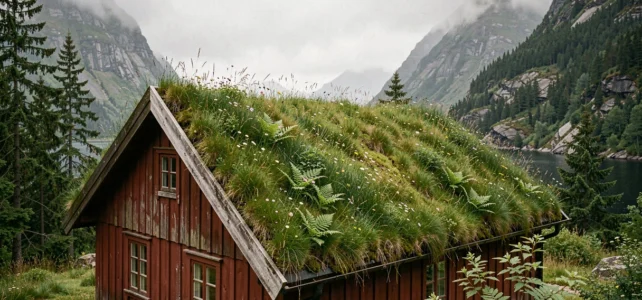
When you step onto a renovation site in the Bergen region, the first thing that strikes you is the thickness of moss on the old roofs. It’s not a maintenance issue: it’s a layer of vegetation intentionally placed, sometimes for generations. Green roofs in Norway are not a recent trend. Their massive return on new houses and renovated buildings addresses concrete climatic constraints that traditional industrial materials struggle to resolve on their own.
Stormwater Management: The Problem the Green Roof Solves First
On the western coast of Norway, rainfall far exceeds what is observed in most European countries. A traditional tile or metal roof drains water directly into the gutters, then into the drainage system. During prolonged rains, the pipes become saturated.
A green roof acts as a buffer. The substrate and root layer absorb a significant portion of the water before it reaches the drainage system. This retention mechanism reduces rainwater runoff at the neighborhood level, relieving municipal infrastructure. Recent modeling of urban green infrastructure in Nordic cities confirms that a high-retention blue-green roof design measurably decreases runoff for sewer systems.
Oslo now incorporates green and blue-green roofs into its climate adaptation strategy, with goals for vegetated surfaces in certain neighborhoods. It’s no longer just about landscaping decoration but a full-fledged stormwater management infrastructure. The green roofs in Norway fit into this logic of urban equipment as much as into an architectural tradition.
Thermal Insulation of Green Roofs Against the Nordic Climate
In Norway, heating is the dominant concern in any construction or renovation project. A green roof adds a layer of natural insulation that limits heat loss in winter. The substrate and vegetation create a thermal mattress that slows exchanges between the interior and exterior.
In summer, even in the southern part of the country, temperatures can rise enough to make a top floor uncomfortable. The plant mass on the roof absorbs solar radiation instead of reflecting or transmitting it. The green roof reduces heat peaks in the attic without resorting to air conditioning, a feature still uncommon in Norwegian homes.
Recent studies in Northern Europe show that green roofs are starting to be integrated into energy renovation scenarios for buildings, alongside traditional insulation and photovoltaic panels. In some aid programs, the treated roof area qualifies for coupled support measures.
What the Structure Must Support
A green roof cannot be placed on just any framework. The weight of the wet substrate and accumulated snow in winter requires precise load calculations. Traditional Norwegian wooden houses generally handle this overload well, as they were originally designed to support grass and soil.
For a recent lightweight frame construction, opinions vary on this point: some carpenters simply reinforce the rafters, while others recommend an extensive system limited to a few centimeters of substrate. The choice depends on the slope, wind exposure, and span of the structural elements.
Reducing Urban Heat Islands: An Issue for Norwegian Cities
Oslo and coastal cities like Bergen or Stavanger are experiencing increasingly frequent heat episodes. Mineral surfaces (asphalt, concrete, metal roofs) store and release heat, creating measurable urban heat islands.
Vegetating roofs cool the ambient air through evapotranspiration. Every square meter of planted roof helps lower the local temperature by a few fractions of a degree. When multiplied at the neighborhood level, the effect becomes noticeable. The municipality of Oslo has integrated this objective into its adaptation plans, with targets for treated surfaces in the densest areas.
It is no coincidence that European climate adaptation programs now include green roofs in their recommendations for Nordic cities. The issue goes beyond the individual house: it impacts the microclimate of an entire urban environment.
Substrate, Vegetation, and Maintenance of a Norwegian Green Roof
The Scandinavian tradition uses birch bark as a waterproof membrane, covered with peat and soil. Contemporary houses replace the bark with synthetic membranes, but the principle remains the same: a draining layer, a substrate, and vegetation suited to the local climate.
The plants used vary according to altitude and latitude:
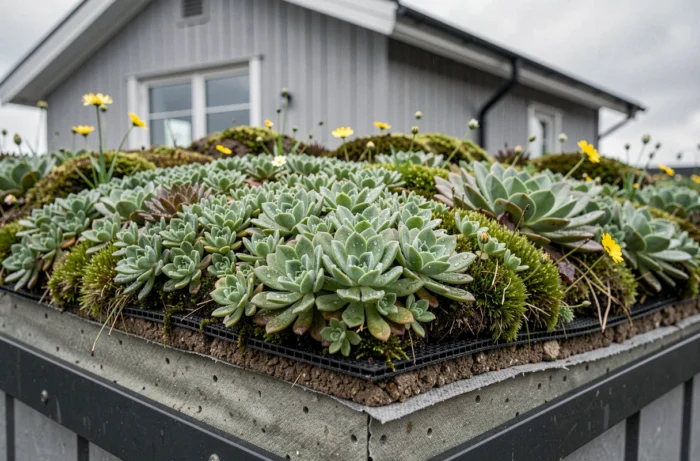
- Sedums and mosses are suitable for extensive roofs in coastal areas, where winters are mild but very humid. Their maintenance is limited to an annual inspection.
- Low grasses and clovers adapt to inland regions, provided the substrate exceeds a few centimeters in thickness to withstand prolonged frost.
- Alpine meadow mixes work at altitude but require a thicker substrate and monitoring of drainage to avoid water stagnation under the snow.
The choice of vegetation depends as much on the roof slope as on the climatic zone. A low-slope roof retains more water, favoring mosses. A steep roof dries faster and is better suited for sedums.
Actual Maintenance Frequency
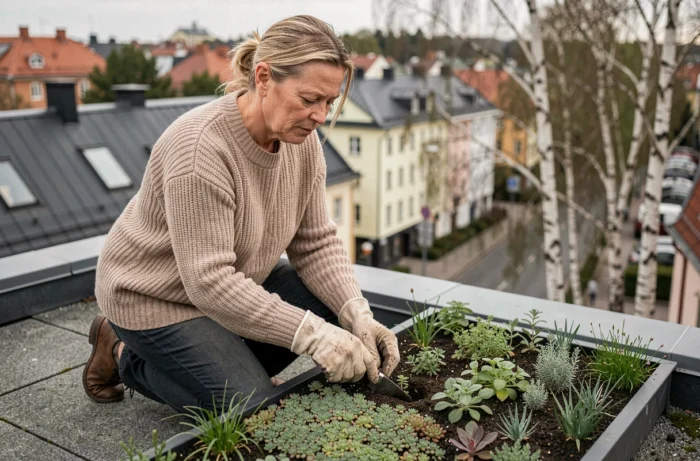
On a well-installed extensive roof, intervention occurs once or twice a year to remove woody weeds (young birch and willow shoots) that could damage the membrane. The rest of the vegetation manages itself. Intensive roofs, which are thicker, require maintenance comparable to that of a small garden: weeding, occasional fertilization, and checking drainage.
Isolated vacation homes, common in the Norwegian mountains, often have green roofs that receive no maintenance for months. The local vegetation naturally reclaims its territory, which is part of the charm, but also the ecological logic of the system: the roof eventually replicates the flora of the surrounding terrain.
What is appealing today about this technique, beyond its picturesque image, is its ability to simultaneously address water management, insulation, and urban thermal comfort constraints. Norwegian cities have understood this by integrating green roofs into their climate infrastructure plans. For individual homes, the calculation remains simple: a roof that works with the local climate instead of against it.