The Swiss real estate market is characterized by very different price dynamics depending on the type of property and the region. Between the scarcity of buildable land and the sustained rise in prices in certain segments, identifying the right property in the right location requires a careful analysis of local data. Finding the ideal real estate in Switzerland means understanding these disparities before embarking on a search.
Prices of houses and apartments in Switzerland: marked regional disparities
The latest indices published in the summer of 2026 reveal a clear phenomenon: the increase in prices for single-family homes exceeds that of condominiums, with a more pronounced monthly increase in August 2026. This divergence is not evenly distributed across the territory.
| Segment | Trend Summer 2026 | Most dynamic regions |
|---|---|---|
| Single-family homes | Increase in almost all major regions | Central Switzerland, Ticino, Mittelland |
| Condominiums | More moderate progression | Varies by canton |
| Affordable housing | Significant decline in supply | Generalized shortage |
Central Switzerland and Ticino show the strongest increases for houses. In contrast, the condominium market follows a more restrained pace, creating different opportunities depending on the buyer’s profile.
For a buyer targeting the Lake Geneva region or German-speaking Switzerland, this data radically changes the budget to be planned. An agency like Alpine Immobilier provides access to a ground-level understanding of these variations, where online portals only display a price without local context.

Shrinking buildable land: what the OFL figures reveal
The Federal Office for Housing (OFL) published an update on its housing market monitoring in September 2026. The finding is unequivocal: the share of unbuilt land zones has decreased from 9.9% to 6.9% between 2012 and 2022. This decline limits the possibilities for new residential projects in already sought-after areas.
This data has a direct consequence on real estate searches. In the most strained cantons, the stock of available properties is mechanically decreasing. Buyers find themselves competing for a reduced number of listings, which drives prices up and reduces the time available for consideration before making an offer.
Affordable housing: a documented drop in supply
According to an analysis reported by Migros Bank and based on data from the Federal Office of Statistics, the supply of affordable housing has dropped by about 60% in six years. Low- and middle-income households are feeling the brunt of this scarcity, combined with high rents for newly listed properties.
This imbalance between supply and demand is not expected to correct itself in the short term. It reinforces the importance of having a local network capable of identifying properties before they are published on major portals or accessing off-market transactions that never appear online.
Real estate search in Switzerland: why portals are not enough
Swiss real estate platforms aggregate a significant share of listings. They remain a logical starting point for any purchasing project. However, their limitations stem from three structural factors confirmed by market data.
- The most sought-after properties in tight areas often sell before publication, through networks of local agencies or direct contacts between owners and brokers.
- A price displayed on a portal does not reflect the actual condition of the property, the specifics of the neighborhood, or the development projects that may affect the value in the medium term.
- The responsiveness required by the current market (multiple offers within a few days) necessitates monitoring that only a locally established professional can provide systematically.
A local expert reduces the gap between public information and ground reality. They know the buildings, the property managers, neighboring construction projects, and potential nuisances. These elements are not included in any listing.
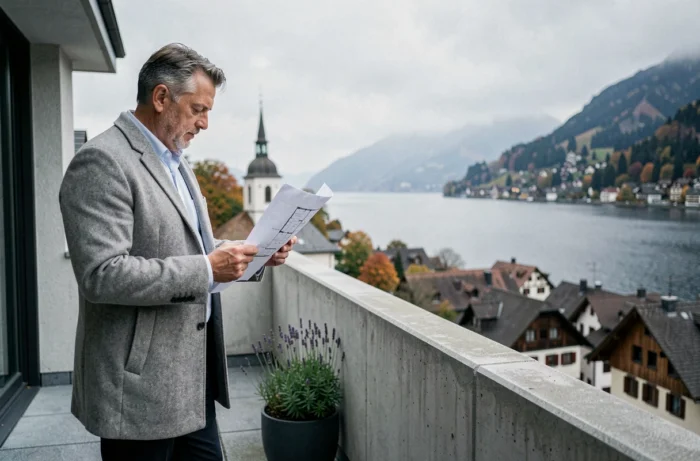
Real estate purchase in Switzerland from France: specific constraints
A significant portion of buyers in French-speaking Switzerland resides in France, particularly in the Geneva border area. For these buyers, the real estate search is compounded by administrative and tax constraints specific to Swiss law.
Acquisition rules vary by canton, residency status, and nationality. The federal law on the acquisition of real estate by foreigners (Lex Koller) imposes restrictions that only permanent residents or holders of a B permit can sometimes bypass. A French buyer without a Swiss residence permit cannot freely acquire a residential property in all cantons.
Financing is another point of friction. Swiss banks generally require a personal contribution of at least 20% of the purchase price, part of which cannot come from the second pillar (occupational pension). The terms of rates and creditworthiness criteria differ significantly from what a French borrower is familiar with in their country.
Taxation and additional costs to anticipate
Notary fees in Switzerland are lower than in France, but other costs come into play: transfer tax (variable by canton), land registry fees, and possibly a tax on real estate gains in the event of resale. The total acquisition cost heavily depends on the canton, making any general estimate unreliable.
Support from professionals established in the targeted canton helps avoid budget errors and administrative blockages that can delay a transaction by several weeks.
The Swiss real estate market in 2026 is defined by a contracting supply and prices that rise unevenly across segments and regions. Buyers who rely on updated data and a structured local network reduce their exposure to additional costs and delays. Local knowledge remains the differentiating factor in a market where every available property attracts multiple candidates.