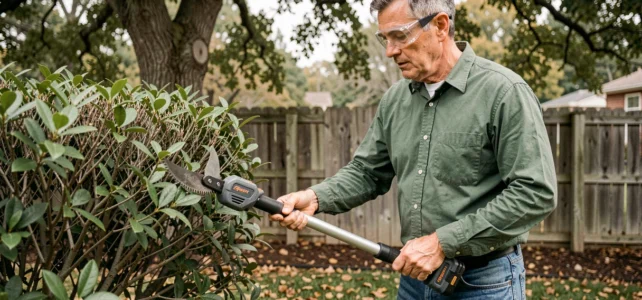
When faced with a linden tree whose low branches rub against the roof, the question of the right tool quickly arises. A pruner that is poorly suited to the diameter of the branches or the cutting height turns a simple job into a risky situation. The choice of a pruner is based on precise technical criteria, related both to the nature of the work and to the safety of the operator.
One-Handed Pruner and Accidentology: A Choice Criterion Often Overlooked by Guides
There are two main families of pruners: the compact chainsaw pruner, known as “top handle,” designed to be operated with one hand at height, and the pole pruner, which allows work from the ground. The common reflex is to choose the lightest and most maneuverable model. This is a mistake if one does not have the appropriate training.
The Ministry of Agriculture, based on MSA data covering the period from 2015 to 2019, notes that tree pruning companies have a work accident rate more than twice as high as the average for the agricultural sector. One-handed pruning chainsaws are identified as a major source of these accidents, particularly when used by unqualified operators.
The official recommendation is clear: reserve the “one-handed” pruner for trained professionals and prioritize two-handed use as an absolute rule. For an individual maintaining their garden, the pole pruner often constitutes the safest option, as it keeps the operator on the ground, away from the cutting zone.
A detailed comparison of the different types of machines can be found on elagueuse-warrior.com, which helps guide the choice according to the usage profile.
Pruner Motorization: Gas, Battery, or Corded Depending on the Job
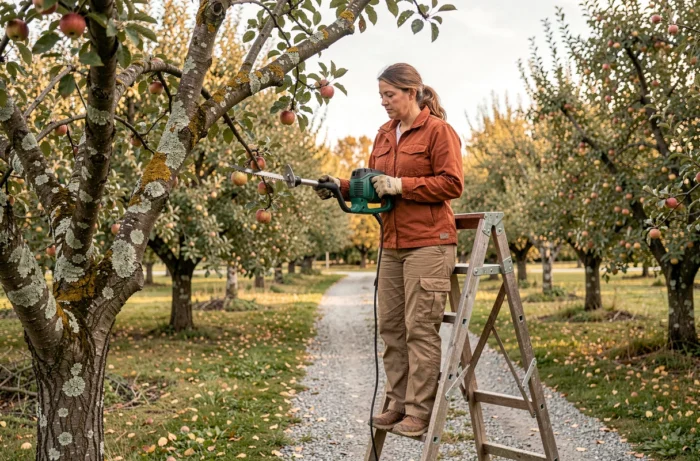
The type of motorization determines both the autonomy, power, and comfort of use. In the field, the choice mainly depends on the frequency of use and the diameter of the branches to be cut.
Gas Pruner: Power and Autonomy for Large Diameters
A gas engine delivers constant power, independent of the battery charge state. It is the logical choice when cutting large diameter branches or working for several hours in a row. The downside: the weight of the engine, noise, vibrations, and regular maintenance (filter, spark plug, oil-gas mixture).
The gas pruner remains the reference for heavy work and jobs far from any electrical outlet. Feedback on comfort of use varies by model, but the consensus is on robustness.
Battery Pruner: The Compromise for Routine Maintenance
Battery pruners have significantly improved in recent years, both in autonomy and motor torque. For an individual pruning a few fruit trees or clearing dead branches, a battery-powered machine is more than sufficient.
The point to watch: real autonomy depends on the cutting diameter. On thin branches, one can easily complete a full session. On hard wood with a large diameter, the battery drains much faster. Having a second battery avoids interruptions.
Corded Electric Pruner: Limited Use but Economical
The corded model is suitable only for work in immediate proximity to the house. Its advantage is the low entry price and the absence of engine maintenance. Its limitation: the cord restricts mobility and creates an additional risk when working at height.
Guide Bar and Cutting Length: Adapting the Tool to the Diameter of the Branches
The length of the guide bar directly determines the maximum cutting diameter. Guide bars of 25 cm to 35 cm are commonly found on pruners. Choosing a guide that is too short requires multiple passes, which fatigues both the chain and the operator. Choosing a guide that is too long adds weight to the machine and reduces maneuverability at height.
- For maintaining tall hedges and branches up to 15-20 cm in diameter, a 25 cm guide covers the majority of a garden’s needs.
- Beyond 20 cm in diameter, a 30 cm guide offers a safety margin that prevents overworking the chain.
- Guides of 35 cm and longer are intended for semi-professional use or for trees with dense wood (oak, beech).
The chain pitch also plays a role. A reduced pitch limits vibrations and improves precision on small diameters, while a wider pitch better evacuates chips on large cuts.
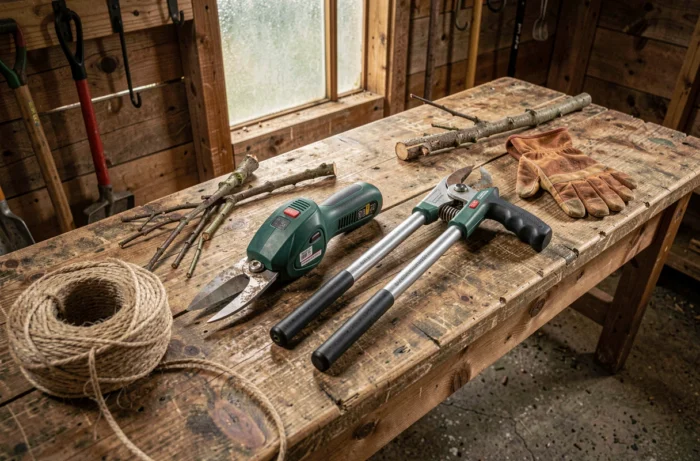
Pruner Safety: Equipment to Check Before Each Use
Safety is not just about choosing the machine. It starts with a systematic check before each cutting session.
- Chain brake: it must stop the chain in a fraction of a second in case of kickback. Test its activation when cold before starting.
- Chain tension: a loose chain can derail during cutting. Check the tension by pulling the chain in the middle of the guide; it should return to place without sagging.
- Anti-vibration: during long sessions, vibrations transmitted to the hands and arms cause fatigue that reduces alertness. Silent block or spring damping systems make a real difference.
- Personal equipment: helmet with visor and hearing protection, cut-resistant gloves, reinforced pants, and safety shoes are not optional, even for trimming three branches in one’s garden.
The use of a “top handle” chainsaw pruner on the ground is prohibited in France, as stated by current regulations (NF EN ISO 11681-2). Using the right machine in the right position reduces the risk of accidents much more than any safety accessory.
Ultimately, the choice of a pruner hinges on three concrete axes: the type of work (height, diameter, frequency), the motorization suited to one’s terrain, and adherence to safety rules that determine the type of machine allowed. An individual maintaining a standard garden does not need a professional model, but they do need a tool they can master and use under the conditions specified by the manufacturer.